It was a lazy summer vacation day, and I was lounging in bed at the Airbnb we had rented in my favourite Ontario vacation destination: Prince Edward County. As I was scrolling through Facebook, an ad from Narcity, a local culture blog, caught my eye. Apparently, they were filming a scene for an upcoming movie with Mila Kunis which required a host of background actors at a posh country club. Sounded fun, so I clicked in. The application was simple enough – essentially you supplied some basic contact and demographic info and availability plus a couple photos of yourself. Of course, I didn’t have any professional headshots, but I found my favourite selfies, including one where I’m in braids and a sports bra, ready for a workout. I submitted it all to the production company and moved on with my vacation.
Honestly, I had mostly forgotten about the whole thing when I got a call from a production company the following weekend. Apparently, I had not been selected for the posh, country-club scene in the Mila Kunis film, but the casting manager asked if I might be interested in another project. Apparently my “natural” style from the last 16 months of COVID hangover, and that photo with the braids, had helped me stand out as a potential Mennonite. The casting manager explained that they were filming an adaptation of the novel, Women Talking. Both the author and the director were Canadian women and one of the producers was Frances McDormand, who would also be playing a role in the film.
He had me at Frances McDormand. I find her to be one of the most compelling, engaging, authentic actors I’ve seen. Her work in Nomadland touched me in a deep and mysterious way, connecting me with ancestors and ways of life foreign and yet familiar.
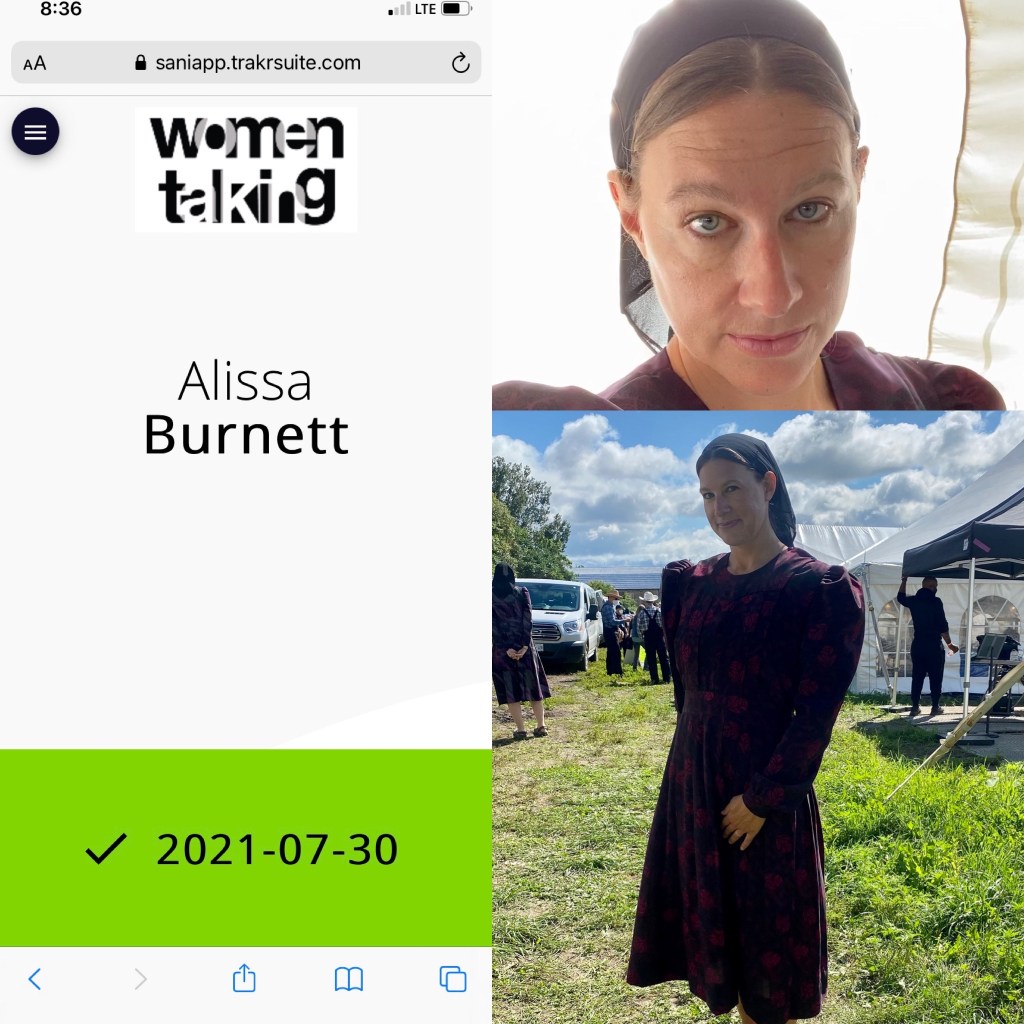
To be included, I would need to pass a COVID test at a designated film studio in the east end 2 days prior. And otherwise, my responsibility was to show up at a remote destination east of Toronto, about an hour drive from my home, at 8:30 am for costuming and hair. On July 30.
July 30? Crap. That’s the birthday of my youngest, Alistair James. He would be turning 4 on July 30, and – as you can imagine, during a pandemic, when there were few bright spots to look forward to, a 4-year-old birthday ranked pretty damn high.
So, I asked him, “Ali, do you want your mom to be there on your birthday, or do you want her to be a movie star?”
He looked a bit bummed, but I told him there was a chance I’d still make it home for pizza and ice cream – and if not, we would 100% celebrate it again the following day. I guess he was sold on the prospect of two potential birthdays, and he agreed. I could take the day to lean into my movie star dreams and make a film with Frances McDormand.
Throughout the prior 5 years that we’ve been living and exploring in the greater Toronto area we saw many locations that we noticed within the host of steaming Disney movies and other TV shows: from The Secret Society of Second-born Royals to the Handmaids Tale, Toronto is a popular destination for filming. Experiencing new and interesting things was one of a host of reasons we chose to live and extend our time there, and this seemed like a great addition to my list. I’m always chasing the adventures and experiences, eager to try something new.
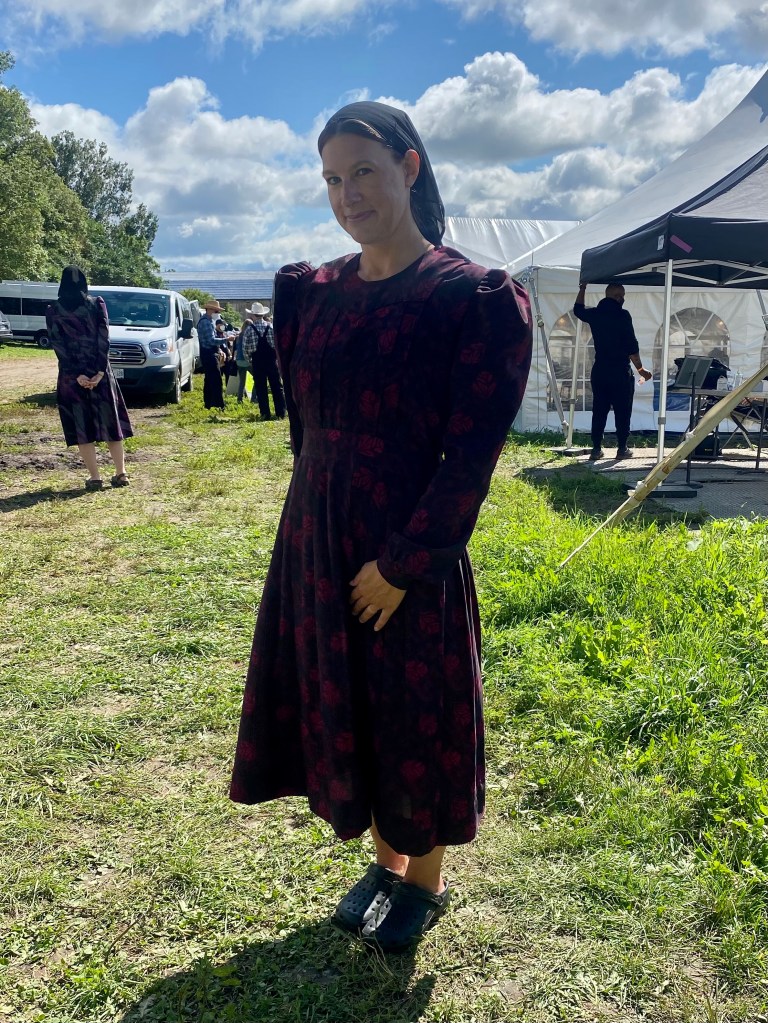
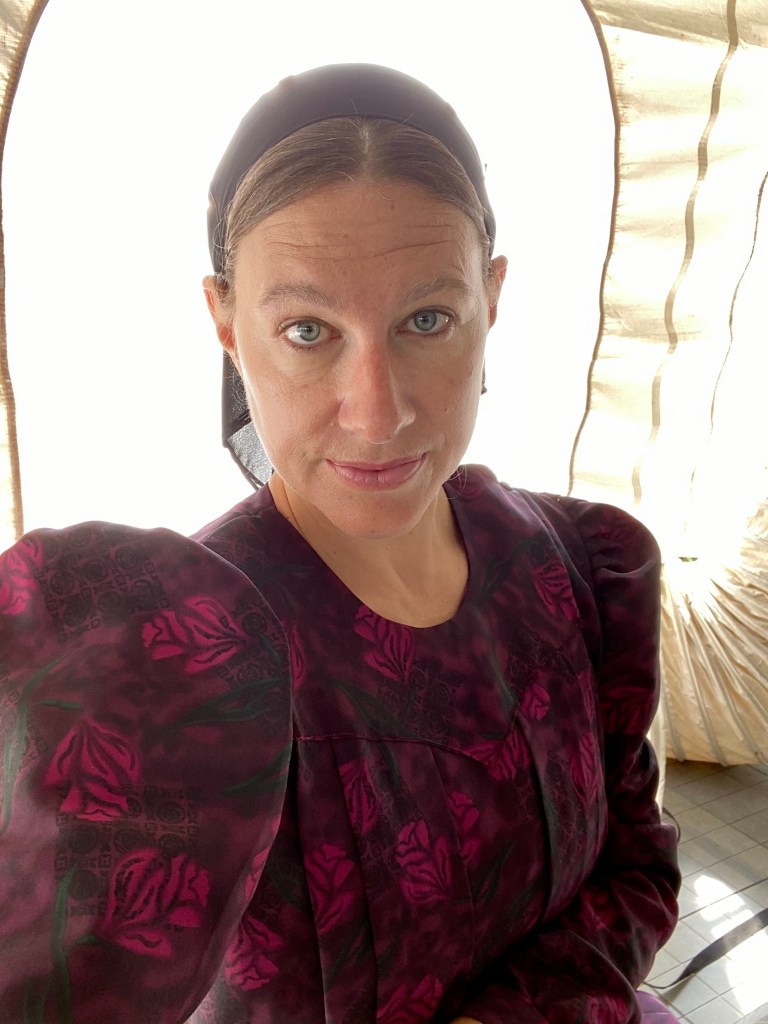
On the designated morning, I drove out to a rural farm and joined my fellow background actors in event tents designated for costumes and hair. All of the dresses were sewn by women from the Mennonite community, and I was assigned one to try on. In my first attempt I actually put it on backwards, and giggled with the costume lady who helped me adjust. Next was a pair of white cotton socks and black Crocs. While some aspects of the movie and costuming may feel like a period piece, in reality, the story takes place in the early 2000s and apparently the Mennonites wear Crocs. Who knew?
Next up was a quick stop in the very limited make-up department to have a tattoo on my wrist covered up. While it should be entirely covered by the long sleeves of my Mennonite dress, they were taking no chances. Following my tattoo make-up, I met an incredibly joyful hair artist who tied off my braids with string before winding them together at the base of my neck and then covering my head with a black mesh scarf.
Mostly the day, thus far, included a lot of waiting. But the other background actors were fun and some had very interesting stories. There was one woman who was likely in her mid or late 60s and does this type of work as her primary income, bouncing from project to project and working as a background actor on the host of films that are captured in the GTA. Many of the actors were part of ACTRA, the Canadian equivalent to the Screen Actors Guild, or SAG.
At one point someone called out that “subs are up.” I thought that meant they were serving submarine sandwiches but apparently this meant that “substantials” were served. This was the primary meal that was served to the cast and crew during our 8-10 hour work day. We ate at portable tables in the tent before getting called for a short walk through the farm to the spot where we were filming the scene for the day.
Sarah Polley, the director, was there and helped set the scene. The gist of it was that the men were leaving to go to town in horse-drawn carriages and we were helping them to pack up the buggies and watching them go. This meant that there were teams of horses and many props. They wanted sort of a smoky haze and were burning a large pile of brush and using fans to direct the resulting smoke in the desired direction. Several cameras, including one mounted on a cherry picker style of crane, moved around to capture the best footage.
The first shots included the men on one side of a dirt, country path and the women on the other. After positioning us in a group facing the road, they brought in the “real” actors: Claire Foy, Jessie Buckley, Sheila McCarthy, Michelle McLeod and Judith Ivey. Immediately you could see the bond these women had formed over the last few weeks of working together. They merged in with the rest of us and we filmed several takes of the two scenes for that day. At one point I was asked to pass a prop crate, filled with artificial sausages, to Jessie Buckley. After executing the same movements close to a dozen times, I like to think we formed a little bond. But smiles were scarce, at least when the camera operator called, “action.” In the story, these women were boiling over with rage and fear and resentment, but they had to mask it in front of the men, who were in total control. The men were the source of this pain and anger and the women needed them gone so they could gather and decide what to do next. As they saw it, there were 3 choices:
- Do nothing
- Stay and fight
- Leave
A powerful story about survival and spirituality, Women Talking explores the theme of how to navigate an impossible situation, through the lens of a woman, a mother, a believer, a daughter, a wife… Although the scene we filmed included no dialogue, the emotions and stories that came through in the eyes of these actors were intense and clear. Jessie Buckley, as Mariche, giving her husband the most subtle but searing glance as he departs. Or the conversations that occurred, without words, between the lead actresses simply through their eyes, or a small graze of a hand. The energy and intensity, the raw need to be safe and yet honour their beliefs.
After about 4 or 5 hours in that dusty field, Sarah carefully reviewing the camera footage between takes, she called it a wrap. She thanked everyone and we walked back to the tents to change and head out. Before going, we were asked to stop by another tent to ensure they had our SIN (Social Insurance Number), essentially the Canadian equivalent of a Social Security Number. This was necessary so they could issue us checks for our work. My husband, Tim, is a professional brewer – and had told me that you become a “professional” once someone pays you for your craft. And thus, it appeared, I had just become a professional actor. Unfortunately, I couldn’t recall or locate my SIN but was told I could follow-up via email and they would mail me a check.
I made the drive back to Toronto, arriving in time to meet the family, including my 4-year-old birthday boy, Ali J, at their soccer match. We had pizza and cake and gifts together back at home that evening, and I felt lucky my aspirations and curiosity hadn’t required Ali to celebrate his birthday without his movie star mom.
In the weeks following, I had a short exchange with the casting company to discuss my SIN, my work permit and likely my eligibility (or lack thereof) to have been paid for a project like this. At that point, I only had temporary resident status in Canada and a closed work permit, essentially prohibiting me from working for anyone in Canada except for my employer. In the end I got a check in the mail – and I hope I wasn’t blacklisted for my questionable work status. (Side note: our family has since gotten permanent residency and are able to work anywhere in Canada)
But clearly it was never about the money. The $150 (give or take) that I made that day was definitely not the motivation. In the coming months, I listened to the audio book of the novel, Women Talking. And I read about the horrific events that this novel was based on, which took place in a Mennonite community in Bolivia.
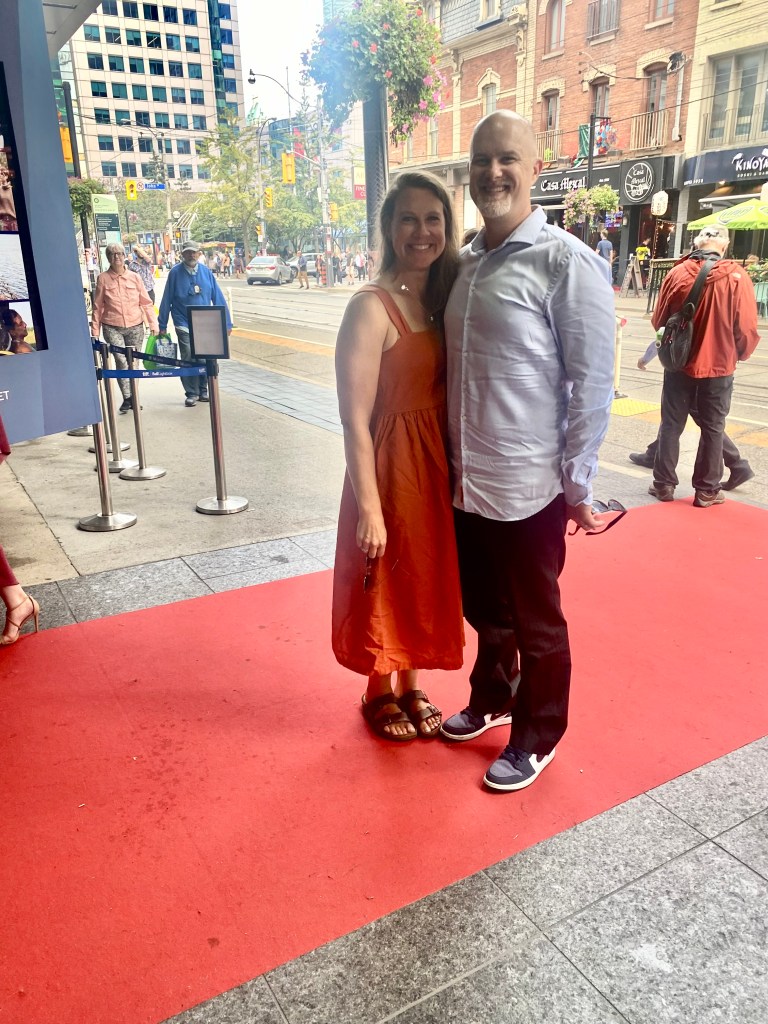
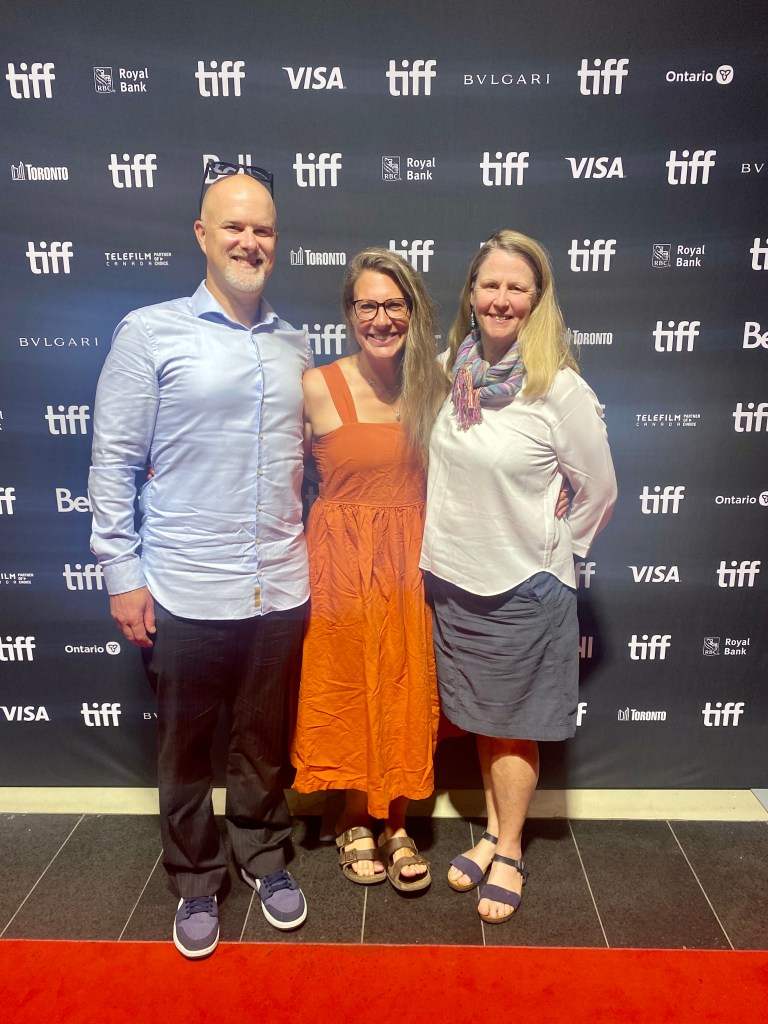
In September of 2022, Tim got us tickets to see the film at TIFF, the Toronto International Film Festival. With emotional anticipation we watched and I tugged on Tim’s arm. It was just a flash – maybe 2 seconds, but I think I was in that crowd of women standing on the side of dirt road. Was I? We also watched Frances McDormand in her small, but powerful role. She was as raw and captivating as ever.
Following the screening, Sarah Polley, the director, hosted a short Q&A. As it turned out, 95% of the footage we had filmed when I was on set was purposely removed from the final edit. Sarah felt the story and focus was more powerful when it remained centered on the women and not the men, even if it involved them leaving. It was almost as though the inclusion of them gave them more power.
Women Talking went on to be nominated for two Academy Awards and Sarah Polley took home the Oscar for best adapted screenplay.
So, was I in it? Did it really matter? The experiences and relationships we build in our lives are what I will always value as most precious. And this opportunity helped me discover a powerful story and share it with a broad network of friends, relatives and colleagues. I added to my own story and helped remind the world to believe women; encouraging women to share their stories, and find their truth.
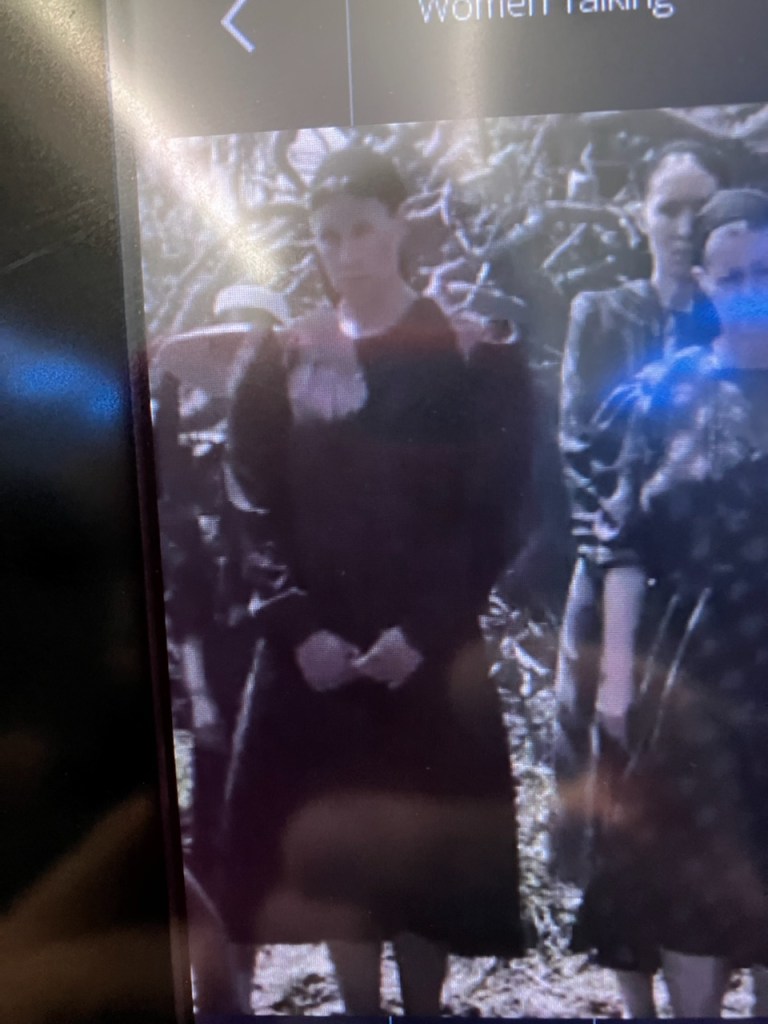
(As a follow-up, my aunt, Reen, who had joined us for the TIFF screening, was later on an airplane and decided to re-watch the film. From her cramped airplane seat, she was able to pause and photograph three glimpses where you can clearly see me standing on that dirt road, right next to Claire Foy, an expression of quiet, simmering rage hidden just under the surface. Reen was keen to point out the quality of my acting, as quiet, simmering rage is a stark diversion from my natural disposition.)


 The [Unofficial] Moth Blog